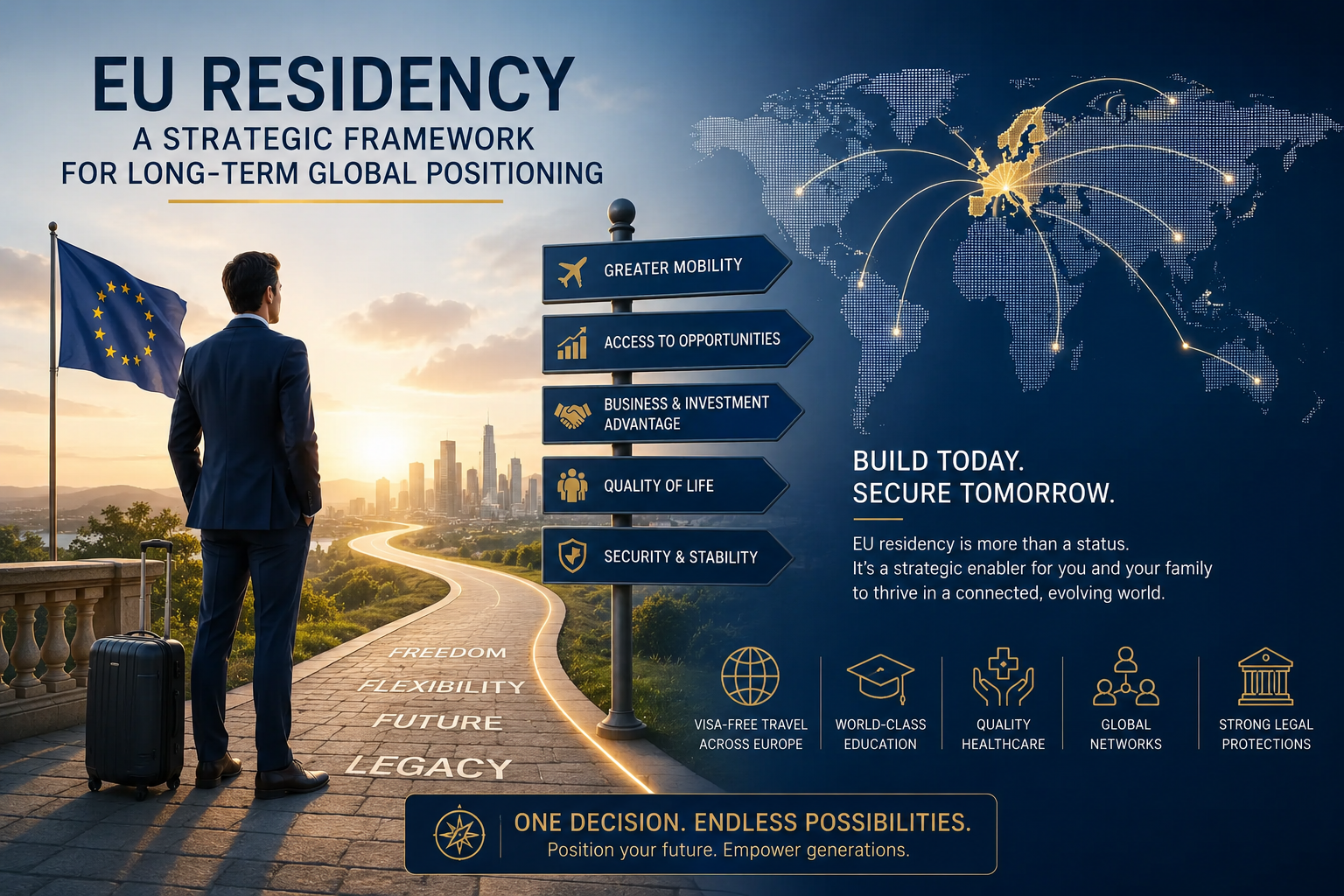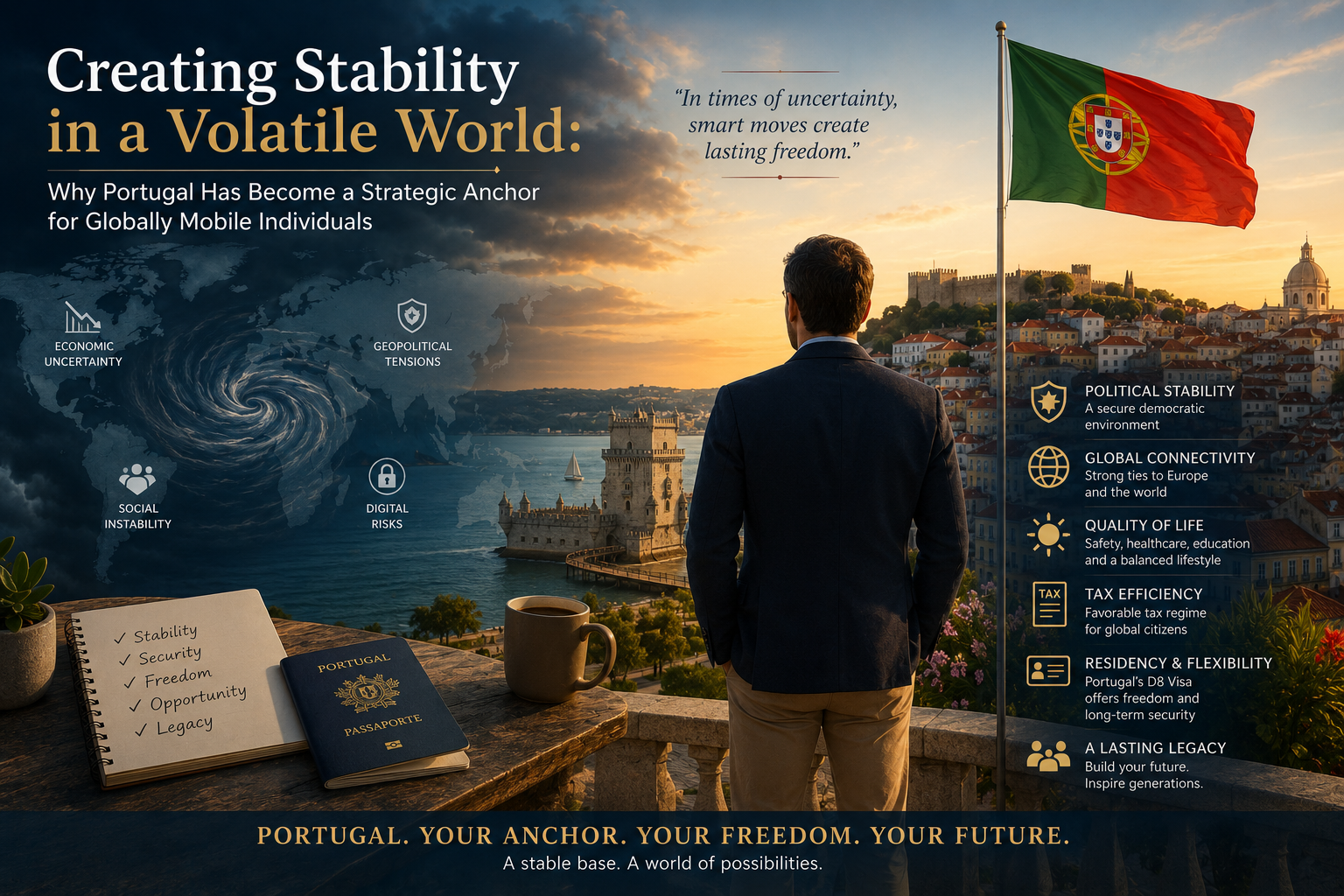
Global volatility today is rarely dramatic in isolation. More often, it is subtle, cumulative, and consequential.
A regulatory shift that alters capital movement.
A policy adjustment that reshapes mobility access.
A geopolitical development that gradually changes long-term planning assumptions.
A financial environment where predictability is increasingly limited.
For globally mobile individuals and families, the question is no longer whether change will happen—but how prepared they are when it does. In this context, stability is no longer passive. It must be intentionally designed.
Portugal’s Golden Visa program has emerged as one of Europe’s most established residency-by-investment frameworks. Its appeal lies not in immediacy, but in structure, predictability, and long-term optionality.
It offers:
Residency within a stable EU jurisdiction
Visa-free movement across the Schengen Area
Relatively minimal physical presence requirements compared to full relocation pathways
A structured route toward permanent residency and potential citizenship over time
Rather than requiring immediate relocation, the framework allows individuals to build long-term optionality while maintaining their existing base. This is not simply about relocation. It is about positioning.
For individuals seeking shortcuts, the structure is unlikely to be suitable. However, for those prioritising stability, flexibility, and strategic optionality, it becomes highly relevant.
In contrast to reactive systems that demand abrupt change, Portugal’s appeal lies in its design principle: continuity without disruption.
The framework does not require:
Instead, it introduces a parallel layer of stability—one that coexists with current realities rather than replacing them. For many investors and globally mobile families, this is where its strategic value becomes evident. It allows individuals to remain grounded while building forward-looking positioning.
Global Mobility as a Long-Term Design Principle
Modern mobility considerations have evolved beyond travel convenience or lifestyle preference. They now reflect deeper structural questions around resilience and continuity, including:
Where can flexibility be maintained if conditions change?
Where can family access opportunities with fewer barriers?
How can continuity be preserved in an increasingly uncertain global environment?
Portugal addresses these considerations through regulated pathways into the European ecosystem—one of the world’s most stable legal and economic regions, supported by more than a decade of Golden Visa implementation.
The emphasis is less on immediate transformation and more on long-term strategic positioning.
What distinguishes Portugal in the current global context is not only access, but structure. It reflects a broader shift in how value is understood:
From ownership alone to ownership with optionality
From immediacy to continuity
From relocation as disruption to layered global presence
In this sense, Portugal is not merely a destination. It functions as a strategic anchor within a broader mobility and residency framework.
Portugal’s Golden Visa program offers multiple qualifying pathways, including investment fund participation, business-oriented structures, and other approved routes, each aligned to different financial profiles and long-term objectives.
For individuals evaluating structured access to Europe, clarity around eligibility, investment thresholds, timelines, and pathway suitability becomes essential in shaping informed decisions aligned with long-term intent.