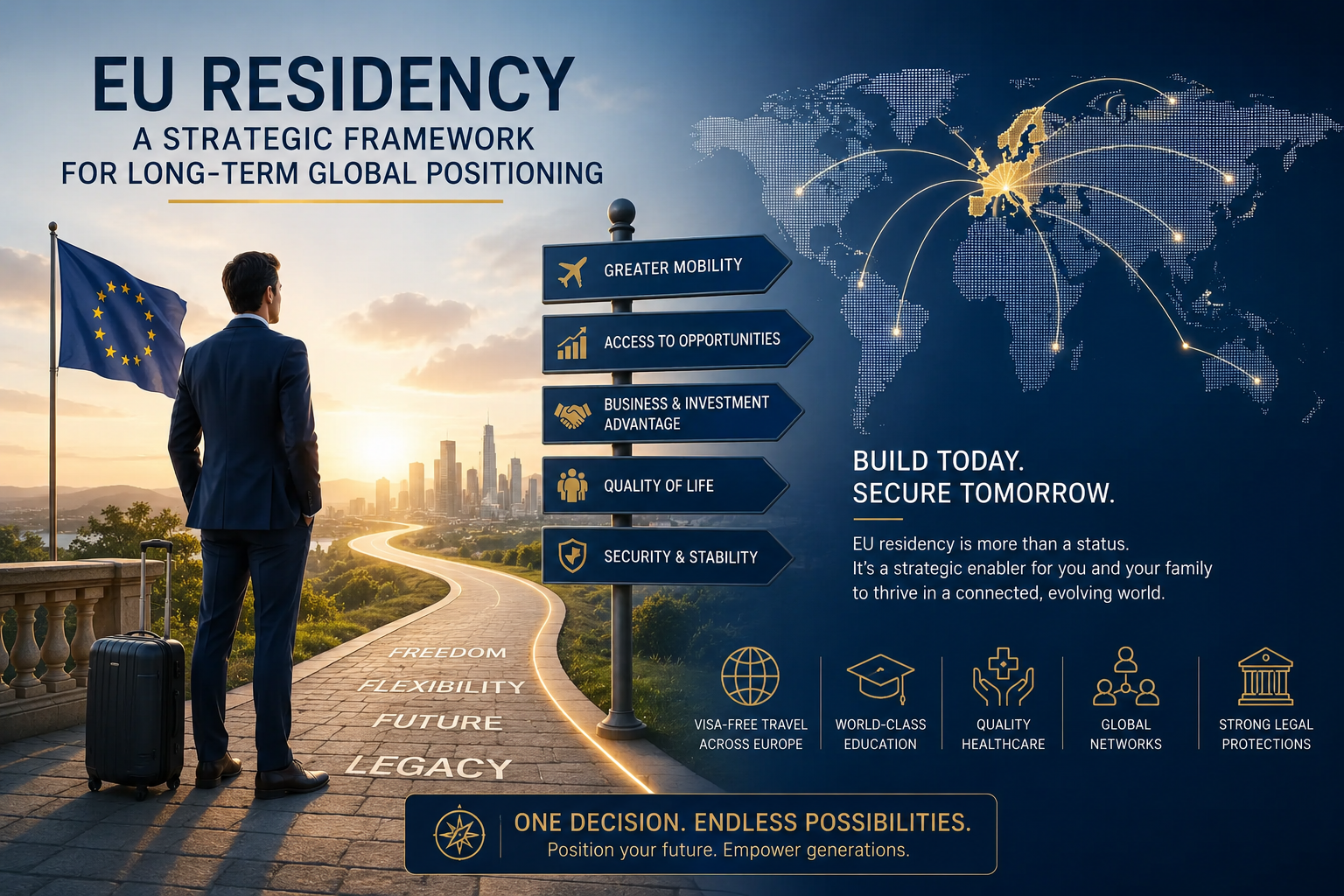
What does it truly mean to hold a “European base” in today’s world?
Beyond the convenience of travel lies a quieter, more enduring advantage—one rooted in structured systems built on regulation, institutional stability, and long-term continuity.
For some, residency is simply about access.
For others, it becomes a deliberate layer within a broader strategy of global mobility, financial planning, and generational positioning.
The difference is rarely in eligibility.
It is in understanding what residency enables—and how it is applied.
Mobility is often the most visible benefit associated with European residency.
In a global environment where borders, visa policies, and entry requirements can shift with limited notice, the ability to move across jurisdictions with ease remains a significant advantage.
EU residency typically provides access across the Schengen Area, enabling holders to travel across multiple European countries without repeated visa applications. This supports a more seamless experience for business travel, lifestyle movement, and opportunity exploration.
However, mobility is only the surface layer.
The more substantive value lies in what EU residency represents structurally: access to systems that prioritize predictability, legal continuity, and institutional strength.
It is not simply about where one can go.
It is about the environment within which one is positioned.
While mobility is often the entry narrative, the deeper value of EU residency is its role in long-term positioning.
European jurisdictions are characterized by regulatory frameworks that emphasize stability and consistency over time. Within this structure, residents benefit from environments where:
This creates a context where individuals are not only moving across borders but are also operating within systems designed for durability.
In this sense, EU residency functions less as a travel advantage and more as a structural alignment with stability.
The value of EU residency becomes most evident when viewed through its progression pathways and long-term implications.
Rather than being a static status, many EU residency-by-investment frameworks are designed as staged systems that evolve over time.
1. Structured Pathways to Long-Term Residency and Citizenship
Several European residency programs follow a defined progression model:
For example, Portugal’s Golden Visa framework—despite undergoing periodic regulatory adjustments—continues to provide a structured route that may lead to citizenship after approximately five years, subject to meeting all statutory conditions.
This progression is not immediate or automatic.
It is time-based, compliance-driven, and structured to reward sustained engagement rather than short-term entry.
2. Low Physical Burden, High Strategic Flexibility
A distinguishing feature of certain EU residency programs, particularly those designed for investors, is their minimal physical presence requirements.
Portugal, for instance, requires an average stay of approximately seven days per year under its Golden Visa framework.
This structure allows individuals to:
In effect, residency becomes an additional layer of access rather than a replacement of existing lifestyle or economic arrangements.
This balance between presence and flexibility is central to its appeal.
3. Integration into a Mature Economic and Financial Ecosystem
EU residency also provides access—direct and indirect—to one of the most developed economic regions globally.
This includes engagement with:
For individuals with international business interests or investment portfolios, this environment offers both depth and diversification potential.
It is not merely access to Europe as a geography.
It is access to Europe as an integrated economic system.
4. Family Continuity and Generational Planning
One of the less immediately visible, yet highly significant, aspects of EU residency is its extension to immediate family members.
Depending on the specific program, residency benefits may extend to:
This transforms residency from an individual arrangement into a family-level framework.
The implications of this include:
In this context, residency becomes less about the present holder alone and more about shaping future opportunities for the wider family unit.
5. A Structural Hedge Against Uncertainty
Perhaps the most understated value of EU residency lies in its role as a stabilizing mechanism.
It introduces optionality in an increasingly uncertain global environment.
At its core, it provides something more valuable than access:
Time.
Time to evaluate decisions.
Time to adjust strategies.
Time to relocate or reallocate—only when necessary, not when forced.
This temporal flexibility is what elevates residency from a mobility tool to a strategic asset.
EU residency, when viewed beyond its surface-level travel advantages, represents a structured form of long-term positioning.
It sits at the intersection of mobility, legal stability, financial access, and generational planning.
For individuals and families operating in a globally interconnected environment, it functions as a framework—one that supports optionality, continuity, and strategic alignment across time.
Ultimately, the value of EU residency is not defined by movement alone.
It is defined by what it enables to be built, protected, and preserved over time.