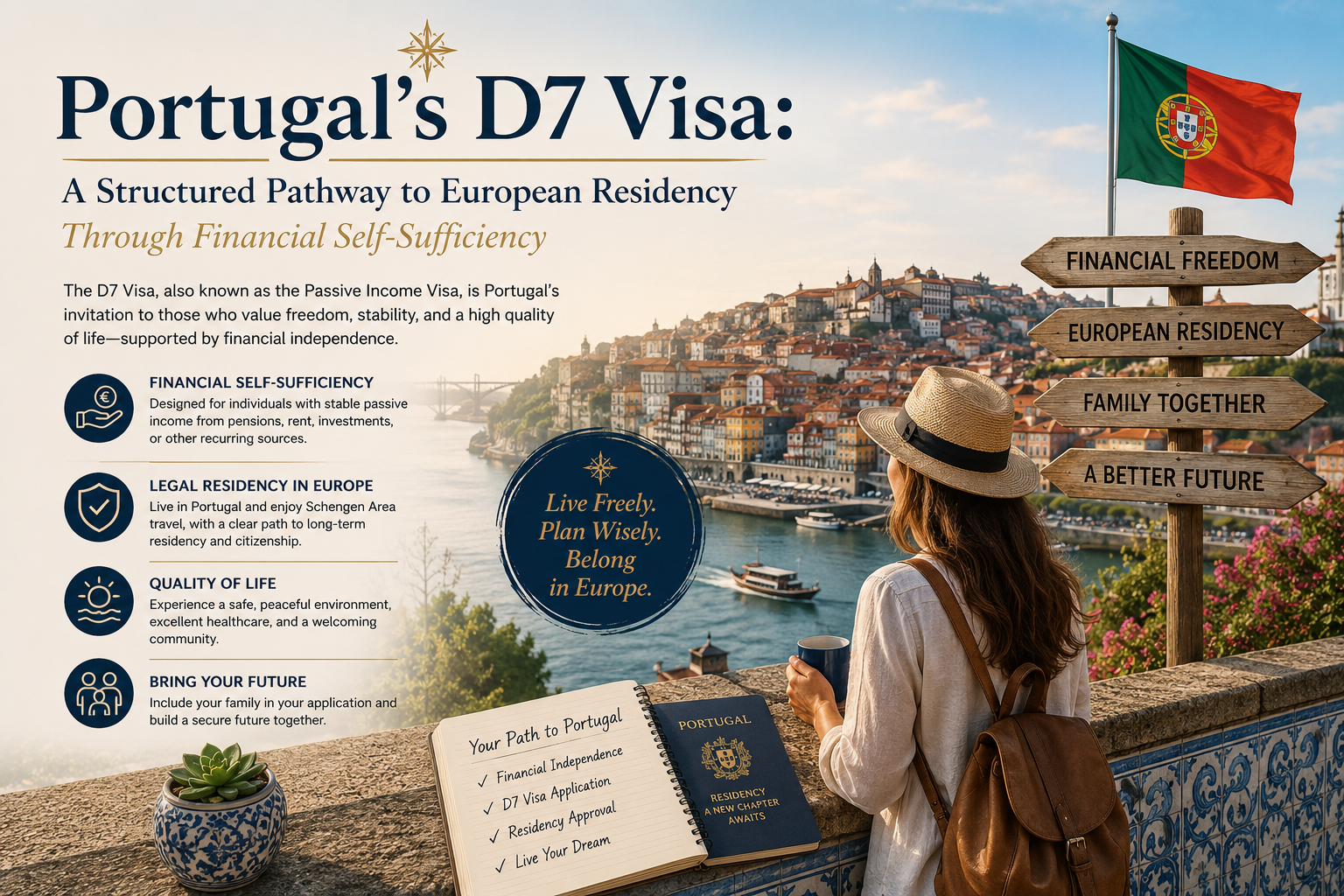
International mobility is no longer defined solely by traditional pathways such as employment sponsorship, academic relocation, or corporate transfers.
A growing segment of globally mobile individuals and families are now exploring alternative residency frameworks that reflect a different kind of qualification—one based not on employer dependence but on demonstrated financial independence.
Among these pathways, Portugal’s D7 Residency Visa has gained increasing attention.
Not as a shortcut to European residency, but as a structured legal framework designed for individuals with stable, recurring income who are able to support themselves without reliance on local employment.
The Portugal D7 Visa is a residency pathway available to non-EU nationals who can demonstrate a consistent stream of lawful passive or stable income.
This income may typically come from sources such as:
Unlike investment migration routes that require significant capital deployment or employment-based visas tied to specific employers, the D7 Visa is fundamentally anchored in the principle of financial self-sufficiency.
The underlying requirement is not wealth concentration but income stability.
Applicants must demonstrate that they can sustain their cost of living in Portugal without becoming a financial burden on the state.
This makes the D7 route distinct within the broader landscape of European residency options.
Portugal has consistently ranked as one of Europe's most attractive residency destinations, particularly among internationally mobile individuals seeking stability, lifestyle quality, and access to the broader European region.
Several structural and lifestyle factors contribute to this sustained interest:
Beyond lifestyle considerations, Portugal is also frequently viewed through a strategic lens.
For many applicants, residency in Portugal represents part of a broader planning framework—one that incorporates global mobility, diversification of residence rights, and long-term flexibility for both individuals and families.
One of the notable advantages of the D7 Visa structure is the ability to extend residency rights to immediate family members through established family reunification provisions.
Eligible dependents typically include:
In certain cases, additional dependents may also be considered, subject to regulatory conditions.
This framework allows families to pursue residency as a collective unit rather than through fragmented individual applications.
As a result, the D7 pathway often becomes part of broader family-level planning discussions, particularly where education access, healthcare stability, and long-term geographical flexibility are key considerations.
Holders of the D7 Residency Visa are generally permitted to engage in professional activity in Portugal, subject to applicable legal and tax requirements.
This may include:
This flexibility allows residents to maintain professional continuity while benefiting from the legal stability of Portuguese residency.
For many, the value lies not in relocation alone, but in the ability to retain multiple economic and geographic options simultaneously.
Although the D7 Visa is widely regarded as one of the more accessible residency pathways in Europe, successful application is still governed by strict procedural and documentary requirements.
A compliant and well-prepared application typically depends on:
At this level, outcomes are often determined not only by eligibility but also by precision in execution.
The framework is clear, but the process demands attention to detail.
Portugal’s D7 Visa represents a structured approach to residency that reflects broader shifts in global mobility.
It is not designed as an investment migration program, nor is it dependent on employer sponsorship. Instead, it is built around the principle of financial independence and sustainable income.
For qualified individuals and families, it offers a legitimate pathway into Europe that supports long-term flexibility, regulatory stability, and access to a broader international environment.
More importantly, it reflects a shift in how residency is increasingly being viewed—not as a destination in itself, but as a component of long-term personal and family positioning.
In many cases, the income already being earned may already meet the threshold for unlocking a new layer of global optionality—provided it is structured within the right framework.