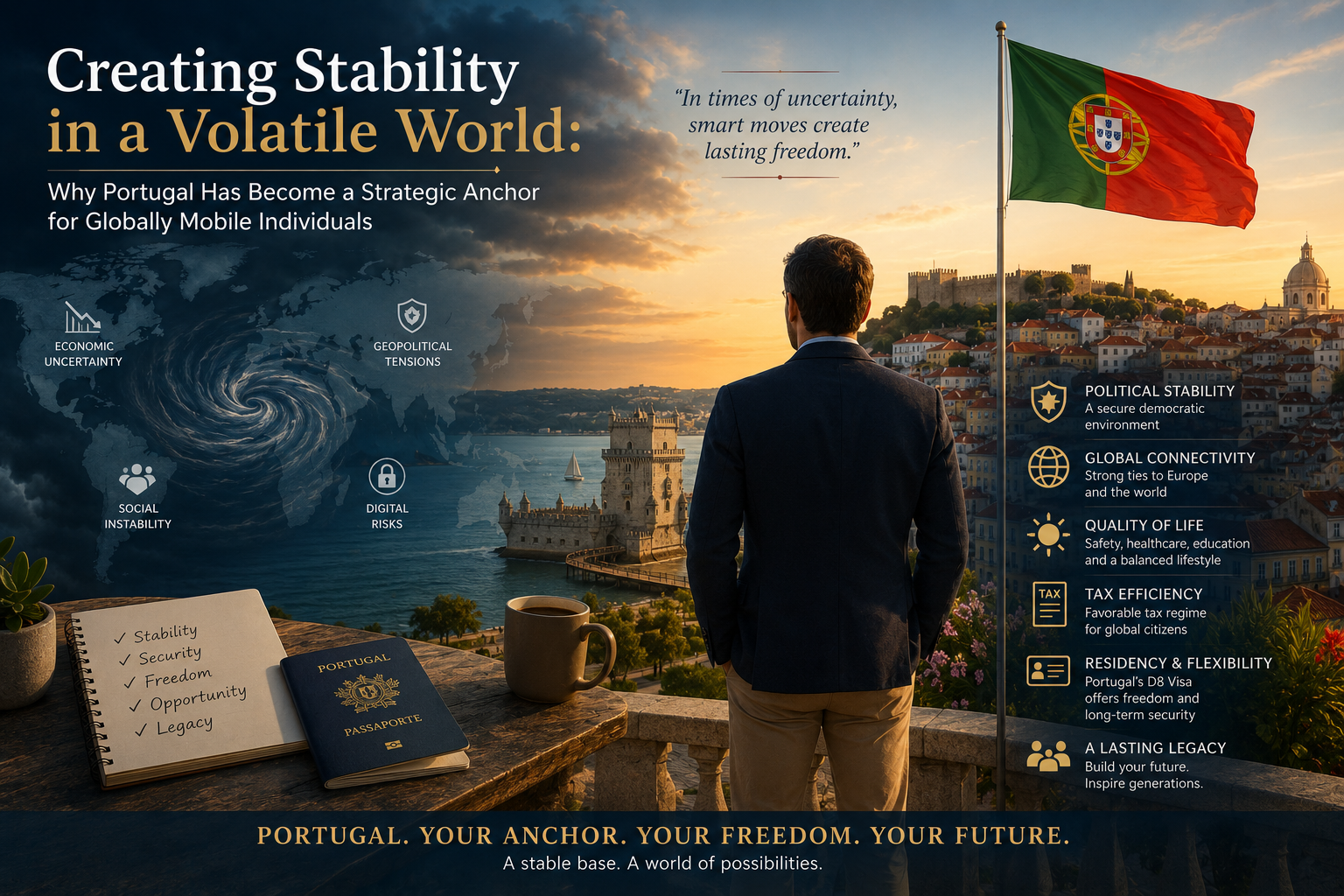
Work has evolved significantly over the past decade. Productivity is no longer confined to a single office, city, or even country. As remote work, freelancing, consulting, and globally distributed business models continue to expand, residency frameworks across several jurisdictions are gradually adapting to reflect this new reality.
One such route gaining growing attention is Portugal’s D8 Residency Visa.
Rather than replacing traditional immigration pathways, it reflects a shift in how mobility, income, and residency are increasingly interconnected in a digital economy.
The Portugal D8 Visa is designed for non-EU nationals who earn income remotely from outside Portugal. It is particularly relevant for individuals whose work is not tied to a local Portuguese employer.
Eligible applicants may include professionals with income derived from:
At its core, the visa recognises a growing category of professionals whose income is location-independent but who still require a structured legal residency framework.
Portugal continues to stand out as a preferred European destination for globally mobile professionals due to a combination of practical, economic, and lifestyle considerations.
Key factors include:
For many applicants, Portugal represents a balance between professional continuity and personal lifestyle enhancement. It is increasingly viewed as a jurisdiction where modern work structures can be supported by equally modern living conditions.
In eligible cases, the D8 Visa allows for family reunification provisions. This means that spouses and dependent children may be included within the application structure, subject to meeting the relevant requirements.
This feature often makes the route more than an individual relocation pathway. For many applicants, it becomes a broader family-oriented residency decision, enabling relocation planning that considers both professional and personal stability.
A central advantage of the D8 framework is continuity.
Approved applicants are generally permitted to continue their remote employment, freelance work, consulting, or independent business activities, provided these are conducted in accordance with applicable regulations.
This ensures that individuals do not need to disrupt existing income structures in order to qualify for residency. Instead, the pathway is designed to accommodate ongoing professional activity while enabling lawful residence in Portugal.
Although the D8 Visa is designed for remote earners, successful applications require careful preparation and documentation. The process typically involves detailed assessment of:
Each of these components plays a role in determining application success. As such, accuracy and consistency in documentation are essential.
The rise of visas such as the D8 reflects a broader global shift: residency is increasingly being shaped by how people earn, not just where they are employed.
For many professionals, this creates new possibilities for structuring life across borders while maintaining career continuity. Portugal’s D8 Visa sits within this evolving landscape as one of several routes designed for the modern, location-independent workforce.
In this context, residency planning is no longer only about relocation. It is about alignment between income structures, lifestyle choices, and long-term mobility options in an increasingly connected global economy.